
Symbols & Traditions
Symbols of the Fraternity
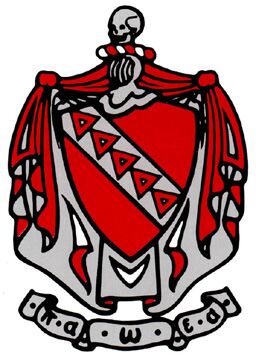
Coat of Arms
Adopted in 1926. A Norman shield with a bend of five equilateral triangles over a scroll bearing the initials of a secret Greek motto, topped by a skull, in cherry and gray. Only initiated members may display it.
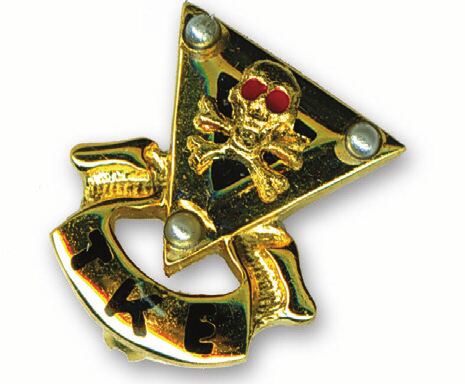
Membership Badge
White or Roman gold with three white pearls, unchanged since adoption. Worn over the heart on collared shirts. Its meaning is revealed at initiation.

Candidate Pin
A cherry and gray equilateral triangle, worn by candidates before initiation, base parallel to the ground.
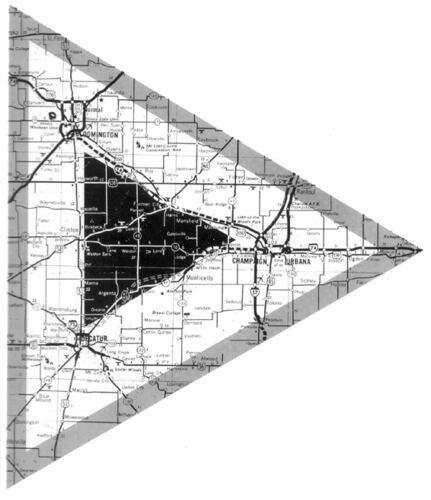
Equilateral Triangle
The primary symbol. It stands for equal development of mind, body and heart, and for the first three chapters (Bloomington, Decatur, Champaign), which form a triangle on the map.
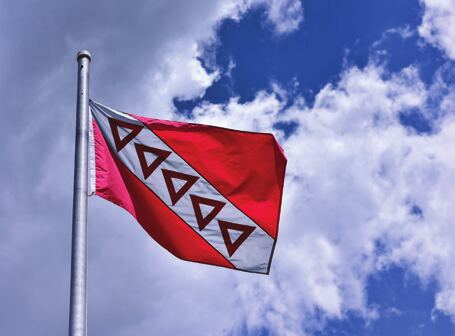
The Flag
Adopted in 1961. Five voided cherry triangles on a gray bend over a cherry field.

Red Carnation
The official flower. Worn at initiations and banquets, and the namesake of the Red Carnation Ball.

Apollo
The patron and mythological ideal: god of light, truth, music and knowledge, and a model of sterling character.

Horseshoe
A symbol of faith, friendship and good fortune. It dates to a 1921 petition from Ohio State. Every new chapter receives one at installation.

Eagle
The official bird of the Fraternity.
Colors & jewel
Jewel: the white pearl.
Traditions
- Founders' Day: on or near January 10. Chapters and alumni honor the five Founders, usually at a banquet.
- Yours in the Bond: letters between Tekes open "Dear Frater" and close "Yours in the Bond" (YITB).
- THE TEKE: the Fraternity's magazine since 1908.
- Mourning ribbon: brothers wear a black ribbon under their badge for 14 days after a member's death.
The Declaration of Principles
We, the members of Tau Kappa Epsilon Fraternity, hereby declaring our strict adherence and unswerving fidelity to what we believe to be the basic principles of true friendship, do ordain and adopt this our Declaration of Principles. The object of this Declaration is to codify the settled convictions of this fraternity into abiding form to guide fraternal action and conduct for all time to come. And to the principles hereinafter enunciated, we individually and collectively pledge our unreserved allegiance.
Man is a social being. Our whole structure evidences the absolute interdependence of man. Reclusiveness is dwarfing to man's best qualities. Intimate and frequent contact with our fellows is necessary to symmetrical development. As a consequence, organizations whose purpose is to promote these ends are to be fostered and encouraged. We believe that at no other period in the life of a man is the time more opportune for the fostering of such qualities than during the years of his college career. Then mind and heart are in their most receptive condition, for it is the formative period of life.
We regard mental development as of vital importance, but of equal consequence is the acquisition of a knowledge of men and a proper conception of their relation to one another. This is not obtained from texts and lectures, but from actual and intimate intercourse with men. To promote these ends is the avowed and earnest purpose of this fraternity. Fully realizing the burdens of this duty, we enter upon its performance with the conscientious purpose of adequately meeting its demands.
We maintain that exclusiveness is the direct antithesis of true fraternity. We condemn the un-American policies of some of the leading college fraternities of the country in their attitude of contempt to all who are without the bonds of fraternities, regardless of character, ability, or personal merits. Such policies we seek to avoid, as they are destructive of the very ends of true fraternity.
We believe that a fraternity should be a brotherhood in conduct as well as in name. "Faith without works is dead." Pledges of brotherhood not succeeded by observance in conduct are as "sounding brass and tinkling cymbal." By the tenor of our daily action we should evidence our devotion to the principles we have solemnly obligated ourselves to observe. The duties and obligations that subsist between the sons of the same mother should subsist between brothers in the sacred bond of this fraternity. The instinct to the observance of mutual duties that common blood supplies, must be furnished by the pledges of our ritual.
We believe that the essential elements of true brotherhood are love, charity and esteem; love, that binds our hearts with the sturdy chords of fraternal affection; charity, that is impulsive to see virtues in a brother and slow to reprove his faults; esteem, that is respectful to the honest convictions of others and that refrains from treading upon that which is sacred to spirit and conscience; these are the triple obligations of every brother in the bond.
We believe in secretism in so far as it enables a fraternity to protect the confidences of the brotherhood. Secrecy that is promoted for selfish purposes or utilized to cloak fraternal wrong-doings we unsparingly condemn. We uphold this policy in so far as it is necessary to insure the dignity of our ritualism and the privacy of our internal affairs. As secrecy is employed to protect and perpetuate the sanctity of the family relation, so we enlist the advantage of secrecy to preserve inviolate the confidences and sanctities of the brotherhood.
Toward other fraternities we believe we should maintain an attitude of dignity and respect, recognizing their merits and studiously avoiding their evils. We believe our relation to them is, in a measure, competitive, and that we should endeavor to excel them in the fields of college activity. We maintain that competition may become detrimental to any school. When healthy rivalry is followed by competition, in which honorable methods are employed, it is a boon to the fraternity, and a benefit to the school, but when groveling and unprincipled means are employed, when school spirit and interest is subordinated to fraternal prejudice and selfishness, it becomes a "snare to the feet," and a detriment to the fraternity and to the school. Competition in such form we condemn, and pledge every effort to avoid.
Finally, above all else, this fraternity stands for Men. We believe in their equality in those things which the Creator has decreed they should equally enjoy. We consider no man from the standpoint of those qualities and advantages he has not attained by personal effort. We stand for men whose manhood has withstood the test of trying conditions. We deem sterling character and staunch uprightness to be the necessary qualifications to membership in this fraternity. All else, though desirable, is secondary to these.